Astrology is made out to be a science by those who practice it while others consider it a form of entertainment. Here we look at the Islamic position on various forms of astrology. The whole position is summarized in the following two Hadiths of Prophet Muhammad (ﷺ):
مَنْ أَتَى عَرَّافًا فَسَأَلَهُ عَنْ شَىْءٍ لَمْ تُقْبَلْ لَهُ صَلاَةٌ أَرْبَعِينَ لَيْلَةً
He who visits a fortuneteller and asks him about anything, his prayers extending to forty nights will not be accepted. [Sahih Muslim 2230]
مَنْ أَتَى … كَاهِنًا فَصَدَّقَهُ بِمَا يَقُولُ فَقَدْ كَفَرَ بِمَا أُنْزِلَ عَلَى مُحَمَّدٍ
Whoever … goes to a fortuneteller and believes what he says, he has disbelieved in that which was revealed to Muhammad. [Sunan Ibn Majah 682]
Both the narrations are authentic and they summarize the Islamic stance very clearly:
- Seeking information from a fortuneteller results in the daily obligatory prayers to be rejected. We do not find anything on believing or disbelieving in the fortuneteller and hence, learn that the warning is severe. A person who only reads his or her horoscope daily, and does not believe in them, will also fall in this category.
- The one who believes in what the soothsayer says has disbelieved in what was revealed to Prophet Muhammad (ﷺ). Accepting astrology is much more dangerous for the faith.[1]
The entire matter is very simple and straightforward; however, those professing Islam while being into astrology present their defense as well. Their primary stance is that they simply decipher the decree of Allah based on some principles.
هِ مَا أَخَذَ، وَلِلَّهِ مَا أَعْطَى، كُلٌّ بِأَجَلٍ، فَلْتَصْبِرْ وَلْتَحْتَسِبْ
It is for Allah what He takes, and it is for Allah what He gives, and everything has its fixed time (limit). So be patient and look for Allah’s reward. [Sahih al-Bukhari 6602]
عَنِ النَّبِيِّ صلى الله عليه وسلم قَالَ “ لاَ يَأْتِي ابْنَ آدَمَ النَّذْرُ بِشَىْءٍ لَمْ يَكُنْ قَدْ قَدَّرْتُهُ، وَلَكِنْ يُلْقِيهِ الْقَدَرُ وَقَدْ قَدَّرْتُهُ لَهُ، أَسْتَخْرِجُ بِهِ مِنَ الْبَخِيلِ ”
The Prophet (ﷺ) said (that Allah said), “Vowing does not bring to the son of Adam anything I have not already written in his fate, but vowing is imposed on him by way of fore ordainment. Through vowing I make a miser spend of his wealth.” [Sahih al-Bukhari 6609]
Allah has decreed everything and what these astrologers claim to do is to attempt to find that out. How they do that is based on a very detailed study of stars, planets, events, dates, occasions and so on. This knowledge was neither gathered overnight nor can it be learned that quick as well. The one who goes deeper into its study has more intricacies and complexities and his predictions are more detailed as well. Astrology began by the people observing the stars and by linking them to seasons, tides, events and so on. The 12 Zodiac signs go back thousands of years; the stars were made in shapes of animals and zodiac names emerged. The shapes and positions of the sun and the moon and the stars form the birth chart of a person – it is taken immediately when one is born. This way detailed and complicated maps were formed and continue to form now as well. This ancient knowledge did not remain stuck in the past but continues to evolve as it did after the discovery of gravity, the invention of telescope when new moons were discovered, when the acceptance of the heliocentric model of the world changed the common understanding of ordinary folk as well.
One could argue that the earth has tilted and sun signs have shifted; moreover, new signs have also emerged and hence, astrology is refuted by science. It is true that astrology is not supported by science but we do not seek to go into science vs. astrology here and only attempt to see whether the logic to defend it is acceptable within Islam.
The two Hadiths presented in the beginning are sufficient to refute any Islamic justification for astrology. There are further narrations as well:
أَلَمْ تَرَوْا إِلَى مَا قَالَ رَبُّكُمْ قَالَ مَا أَنْعَمْتُ عَلَى عِبَادِي مِنْ نِعْمَةٍ إِلاَّ أَصْبَحَ فَرِيقٌ مِنْهُمْ بِهَا كَافِرِينَ . يَقُولُونَ الْكَوَاكِبُ وَبِالْكَوَاكِبِ
Don’t you know what your Lord said? He observed: I have never endowed My bondsmen with a favor, but a section amongst them disbelieved it[2] and said: Stars, it was due to the stars. [Sahih Muslim 71, 72; similar narrations are found in Sunan an-Nasa’i 1524, 1525, Sunan Abi Dawud 3906, Muwatta of Imam Malik 13/455, Sahih Muslim 2220 iv; and Sahih al-Bukhari 846, 1038, 3850, 4147 among others]
Would the Islamic stance on astrology be different if one were to attribute the goodness to Allah and not to the star itself? If one believes that Allah would provide him with good if the sun, moon and the stars align in such and such a position, would it be acceptable to the Muslims? The answer to this question is also no and the Prophet (ﷺ) made it very clear as always:
مَنِ اقْتَبَسَ عِلْمًا مِنَ النُّجُومِ اقْتَبَسَ شُعْبَةً مِنَ السِّحْرِ زَادَ مَا زَادَ
Whoever learns about the stars, he learns a branch of magic; the more he learns (of the former) the more he learns (of the latter). [Sunan Ibn Majah 3726]
Magic is forbidden in Islam and is one of the greatest sins.[3] Astrology is a branch of it and is forbidden as well.
What about good omens?
Bad omens or superstitions are also forbidden in Islam.
الطِّيَرَةُ مِنَ الشِّرْكِ - وَمَا مِنَّا إِلاَّ وَلَكِنَّ اللَّهَ يُذْهِبُهُ بِالتَّوَكُّلِ
Tiyarah (bad omen) is from shirk (polytheism), and none among us (it influences), except that Allah will remove it with Tawakkul (reliance). [Jami’ al-Tirmizi 1614]
The Prophet (ﷺ) however, liked and allowed good omens:
يُعْجِبُنِي الْفَأْلُ الصَّالِحُ وَالْفَأْلُ الصَّالِحُ الْكَلِمَةُ الْحَسَنَةُ
I like a good omen. Good omen means a good word. [Sunan Abi Dawud 3916]
A detailed study of good omens is essential and this link must not be missed.
What we have learned and established is that fortunetelling, soothsaying, horoscopy, and believing in bad omens is not just forbidden in Islam but they also form a part of polytheism. However, the question now is that of good omens – since Islam allows them, would it not be acceptable to take them as base and create some form of analysis? In simpler terms, would Vastu Shastra or Feng Shui be acceptable to Islam?
To understand this, we would need to discuss some practical examples. Suppose a person started his business on the first of Muharram (the first Islamic month) and it performed very well. Later he established the idea on himself that he needs to begin things on the first of the month to get a better result. In this example, he does not attribute the goodness to Allah and so very easily falls into polytheism as he, knowingly or unknowingly, attributes the source of success to others besides Allah.[4]
If he attributed the success to Allah, then he would still be sinning by following this approach of assigning some days as better in fortune. This would be akin to putting limits on Allah theoretically as if He only helps on these days or that Allah is bound to help if work is commenced on this day. Moreover, this would also be an innovation in the religion.[5]
A positive omen is not unconditional and must be followed with the following essential conditions:[6]
- The source of goodness should be believed to be Allah
- It should be about optimism about Allah
- Anything that increases one’s optimism about Allah is a good omen
- They should not be made into conditions applicable and valid for everyone in all situations
An example based on these conditions would be a man praying to Allah on a cloudy day and when he opens his eyes, he sees a rainbow; he believes that Allah is with him and will answer his prayer based on this sign, then this would be a positive omen. On the other hand, if someone makes it a condition that whenever there is a rainbow after prayer, good will come one’s way, then that would be shirk, and if he believes that good will come his way by the Will of Allah, then he would be limiting Allah to conditions which he made himself and would be introducing something new to the religion which is something not accepted in Islam.
Therefore, we learn that creating limits is un-Islamic and if one were to believe that opening an office next to a stream of water would bring in wealth or placing plants in some directions or keeping money plants in the office would result in money to pour in, then that would be rejected by Islam.
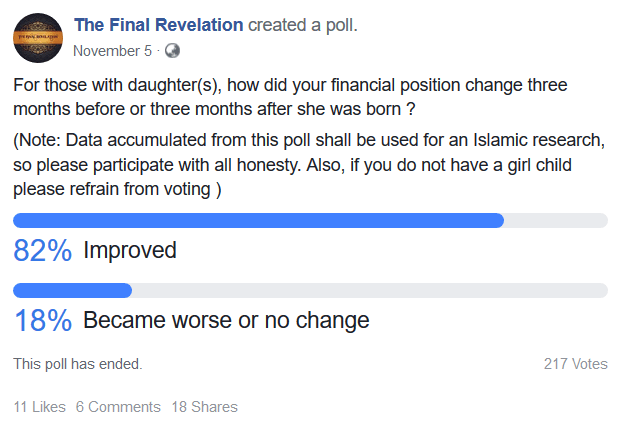
If something works for one, one does not make it a science to be applied to everyone else. Moreover, one should not make it a condition to apply to himself as well. An example would be the birth of daughters; in some Muslim cultures, a daughter’s birth is considered a source of increase in wealth and livelihood. Allah blesses some and withholds from some due to His limitless wisdom. As observed in a recent poll, the belief was not applicable to all.
Conclusion
Astrology is forbidden in Islam and is akin to disbelief. Bad omens are also a form of polytheism whereas good omens are a part of Islam. Sciences that spring out from these are also forbidden in Islam and are also branches of polytheism and magic. Good omens are allowed but with conditions which are that the source of goodness should be believed to be Allah, it should be about optimism about Allah, anything that increases one’s optimism about Allah is a good omen, and they should not be made into conditions applicable and valid for everyone in all situations.
Indeed, Allah knows best.
References and footnotes:
[1] Scholars have discussed this disbelief due to believing in fortunetelling and vary over the extent of it. In brief, all of them agree that this act is an act of disbelief but the point of disagreement is whether it turns one out of the fold of Islam or not.
One groups argues in favor while the other states that an odd or isolated belief in some particular incident is an act of disbelief but does not turn one a disbeliever.
An example could be that a man walking down a street encounters a scary looking person who foretells him that if he continues this way, he would encounter misfortune for the coming full year. The man, although not a believer in fortunetelling, feels uncomfortable and changes his path. This would be a mistake that he did showing a weakness in faith and did an act of disbelief but did not do something that would make him a Kafir.
Similarly, someone who forwarded an email stating ‘forward this to 10 people or else misfortune will come your way for 10 years’ would have shown great weakness in faith and would have performed an act of disbelief but would not become a Kafir only because of this. This group of scholars states that the one who is continuous in believing in fortunetelling is the one who is a disbeliever and therefore, no longer a Muslim.
[2] Some narrations state that they became disbelievers (Kafir). This goes to show the severity of believing in stars.
[3] Magic and Islam | Learning magic is Kufr.
[4] Uzr bij Jahl or ‘excuse due to ignorance’ is a different subject and may or may not apply to such a person; however, the concept of attributing success to someone besides Allah is definitely shirk.


 Qur'anic misconceptions addressed
Nice 👍
Salam u alaykum brother Abu Rahma, I hope you are well and I am sorry for asking another question as this is my second question to you this week, I hope I am of no botherance and may Allah forgive us all. How would you refute this?
“ https://wikiislam.net/wiki/Scientific_Errors_in_the_Quran#Earth_created_before_stars “
Which seems to assume that in 41:11/12 the Quran states that the Earth is older than stars and also they mention a statement of Ibn Abbas mentioning the Earth is older than everything? Jazak’Allah khair brother for everything, sincerely thank you.
Wa’alaykumusSalaam wr wb. Please take a look here:
https://qurananswers.me/2013/12/22/six-days-of-creation/
https://qurananswers.me/2017/06/24/criticism-religion-western-thought/#8
Asalam Alykum
I stumbled on an article
https://embryologyinthequran.blogspot.com/?m=1
(Embryology in the quran much ado nothing )was an article against Hamza , here he tried to prove that nutfah is semen by showing 23:13 and 77:20-22 . Also he showed many hadiths and islamic dictionary like lisan al arab and lane lexicon. He also showed few references from babylonian talmud for example
Clinging substance and Man is not made from all drop but from its purest part . Rebuttal needed. Please
Wa’alaykumusSalaam wr wb,
I have done a skim review of the site you shared and believe that what you’re saying is addressed here: https://qurananswers.me/2017/08/26/gender-determination-hadith/ There is useful info. in the comments as well.
Yes but few points like stages of alaqa and mudgaha and its meanings were also refuted in that article . Please if you look into that matter it would be a big help!
And also the section where it says that bones are clothed with flesh , he gave a scientific explanation which i am unable to understand.
Here is a useful piece worth reading: https://www.ncbi.nlm.nih.gov/pmc/articles/PMC3068791/
I have been reading the articles and I do not find much there to address. His focus is more on refuting Hamza Tzortzis and for that I would need to go further back to see how he presented everything. So, to make things simple, I looked at the piece by WikiIslam here: as they compile everything into one place.
I find their stance quite amusing. They categorically denied copying from Greek sources or Talmud stating: ‘However, while interesting and very probable, these influences cannot be proven for the Quran, and it is in any case unnecessary when examining the accuracy of the Quranic descriptions’.
At least they are honest here and it appears that they couldn’t defend the allegation of plagiarism so conceded this to the Muslims.
Then they go ahead with some criticisms and blunder right from the beginning. They state: ‘The Quran claims that bones are formed before being clothed with flesh. In fact cartilage models of the bones start to form at the same time as and in parallel with surrounding muscles, and this cartilage is literally replaced with bone.’
The verses use the word ‘thumma’ (ثُمَّ) which is not necessarily sequential but has other meanings as well: It is also used to emphasize and indicate the recurrence of an event. The following example makes it clear:
ثُمَّ يَجْلِسُ وهو يَتكلَّم ثُمَّ يَتكلَّم بدون انقطاع
“Then” he sits while he speaks; “moreover“, he speaks without interruption.
Two ‘thumma’ in the same sentence but both have a different meaning. Anti-Islamic claims always try to force a sequence and be dishonest. Thumma can mean ‘then’, ‘moreover’, and ‘simultaneously’, ‘at the same time’, ‘on top of that’ etc.
The Wiki site claims: ‘Furthermore, there is no sign that the author of the Quran was aware of the female egg (ovum)’ and this is blatantly false. Please refer to the first link I’ve shared at the top of this comment [also copied here] which has the references to refute this false claim.
They acknowledge that the word ‘alaqah’ has other meanings but refuse to apply them and state: ‘Regardless of alternative meanings for this Arabic word…’ At least they admit that there are alternate uses but they don’t want to apply the alternate meanings. Why? We know the reason 🙂 but if we assume positive about them, then the answer would be that their understanding capacity is limited here because they ignore the grander context. The Qur’an is not just for our times, it is for the future as well and the past too. The following passage describes something that is from the brilliance of the Qur’an:
Ponder over this. This is a very educative quote from Tafsir Majidi.
I may write down a detailed piece refuting their arguments (but most likely not needed); however, I see that their stance is very shaky and on weak grounds. It just bothers them to insanity that some non-Muslim scientists affirmed the verses. They find the menacing warnings in the Qur’an somewhat disturbing and wish to gain peace of mind [They said it themselves].
Thank you so much akhi ❤️ for clarifying can i ask you again if i am in doubt?
My pleasure and you’re welcome anytime.
Just one question as we know that the meaning of alaqa is clinging substance but quran states that we changed alaqa into mudgaha but as we know that the embroyo clings for 9 months not only in the alalqa stage . Quran says that alaqa was changed into mudgaha does it imply that the clinging stopped at mudgaha stage?
There’s no such implication. The clinging happens (alaqa) and then it changes to mudgaha while the clinging remains.
Asalam walykum
Can you please check point no. 7 to 11
As they are refutting the alaqa to be clinging substance
Does the word mean clinging blood clot?
Salam walykum
I am so sorry due to my lack of knowledge in the field of embroyology and islam.
https://wikiislam.github.io/wiki/Embryology_in_the_Quran.html
I stumbled on the formation of bones section in the above link . Can you please find a rebuttal for the link above especially the formation of bones column which comes first bones or flesh
I am very stressed due to this please help!
Can you please check the references he gave to debunk the quranic claim of bones and muscles
Pingback: İslam'da Astroloji ve Burçlar Haram mı? Ayet ve Hadislerle İnceleme